
Memory Price,Memory market,ssd price,ssd price trend,enterprise ssd, consumer ssd, industrial ssd
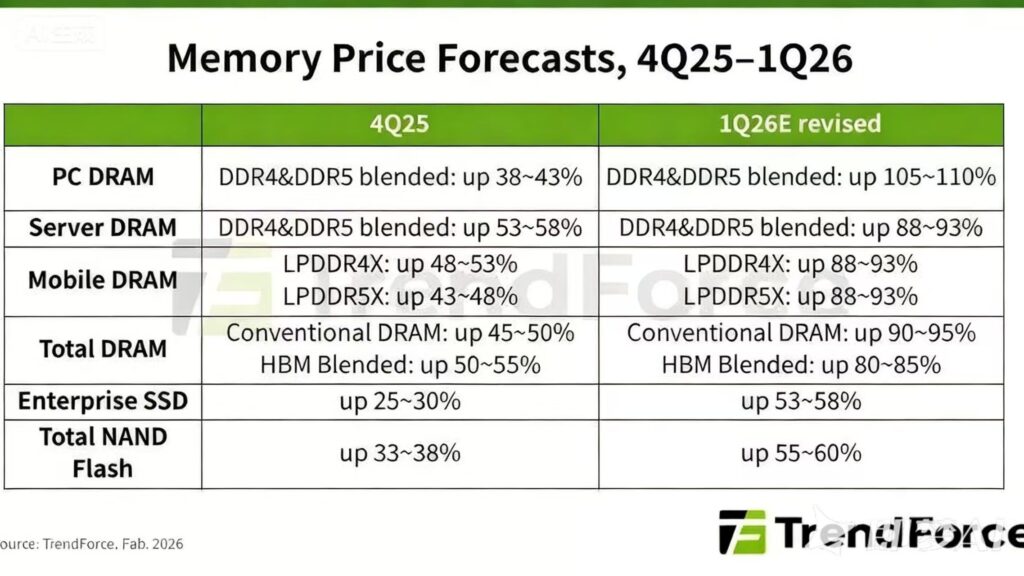
According to the latest memory market tracking, memory price surged 80–90% till Feb. in Q1 2026 vs Q4 2025. Both DRAM and NAND are hitting historic highs, and Q2 2026 is projected to bring another 15–20% increase on average. (Read my post https://www.linkedin.com/posts/jasminehong1_ssd-market-forecast-price-surge-what-share-7434540099310190592-TFcT?utm_source=share&utm_medium=member_desktop )
🛩️DRAM & DDR5 Prices Surge as Capacity Shifts to HBM
DDR5 32GB kits have climbed above $350 in several markets. In parts of Europe, prices jumped more than 300% within months.
This is not speculation-driven volatility — it is capacity migration.
According to TrendForce, Q1 2026 DRAM contract prices are expected to rise 90–95% quarter-over-quarter, with PC DRAM potentially exceeding 100% growth.
🛩️Enterprise SSD: A Structural Reset, Not a Temporary Spike
Enterprise SSD pricing has entered unprecedented territory. Certain high-capacity models have increased more than 250% year-over-year.
PCIe 5.0 has now become the standard in high-performance data centers, delivering speeds near 15 GB/s and significantly higher IOPS. Capacities are shifting upward, with hyperscale customers prioritizing 30TB, 60TB, and even 120TB-class drives.
🛩️Consumer SSD: Following the Trend, But Not Yet Out of Control
PCIe 4.0 remains the mainstream sweet spot for consumer markets, maintaining a relatively stable value window. PCIe 5.0 adoption is growing in high-end gaming and content creation, though platform compatibility and thermal requirements limit mass adoption.
Price increases are visible but remain more controlled compared to enterprise segments.
🛩️Industrial SSD: The Quietly Impacted Segment
Industrial SSDs are often overlooked in mainstream SSD report, but they are also experiencing meaningful pressure. Certain specifications have risen to 60%, with noticeably extended lead times.
🛩️Market Outlook: Waiting May Cost More Than Buying
If you are still expecting memory or SSD prices to decline in 2026, current data does not support that assumption.
Major research reports from TrendForce, IDC, and Gartner point toward elevated pricing throughout 2026, with meaningful correction unlikely before late 2027 or early 2028.
In this environment, the cost of waiting may exceed the cost of securing supply.
From where I stand in the SSD manufacturer ecosystem, the most important shift is not just pricing — it is priority.AI workloads are redefining which products receive capacity, which customers receive allocation, and which markets must adapt.
As someone passionate about SSD manufacturing and supplying, I’m excited to see where this growth takes us.